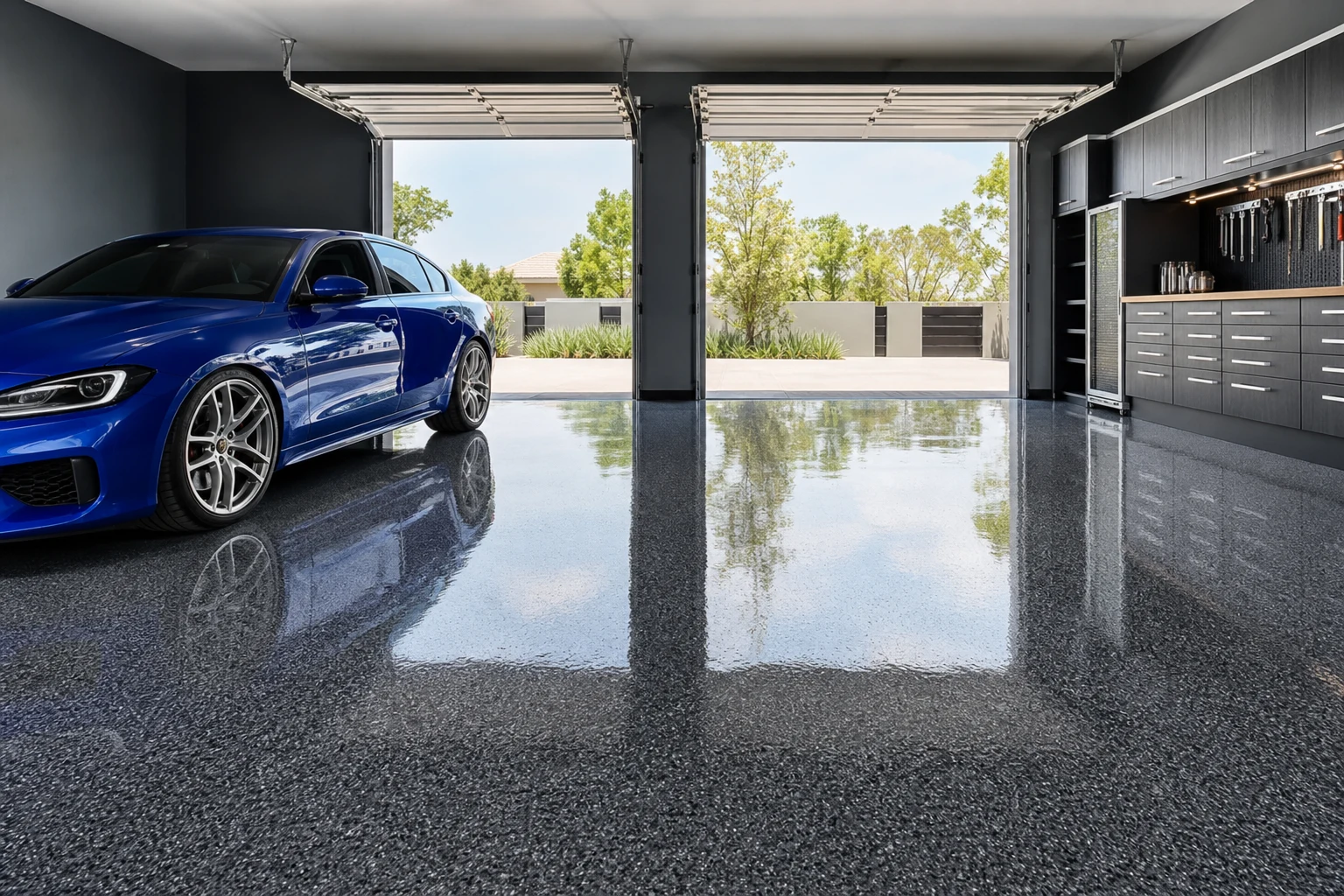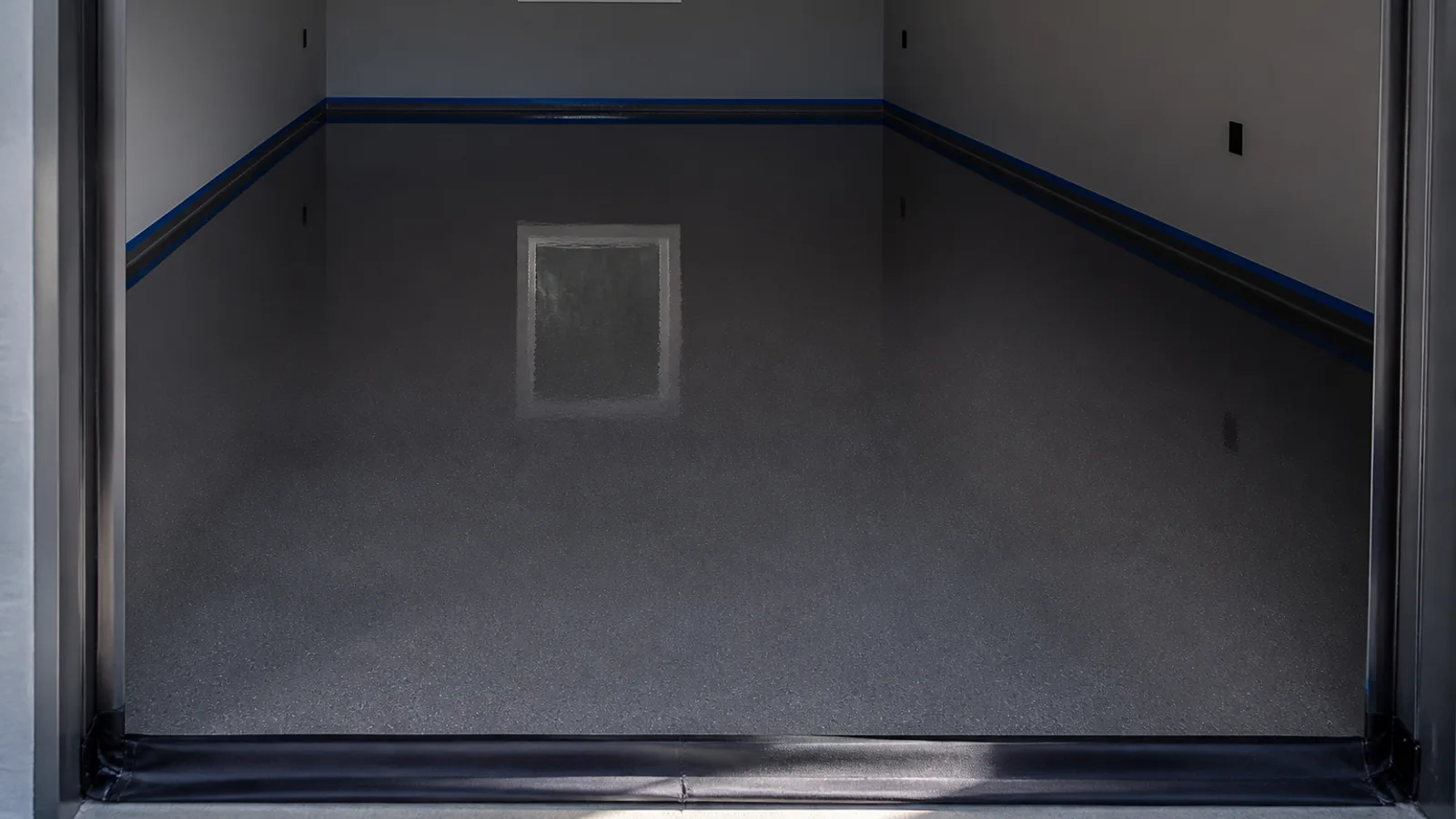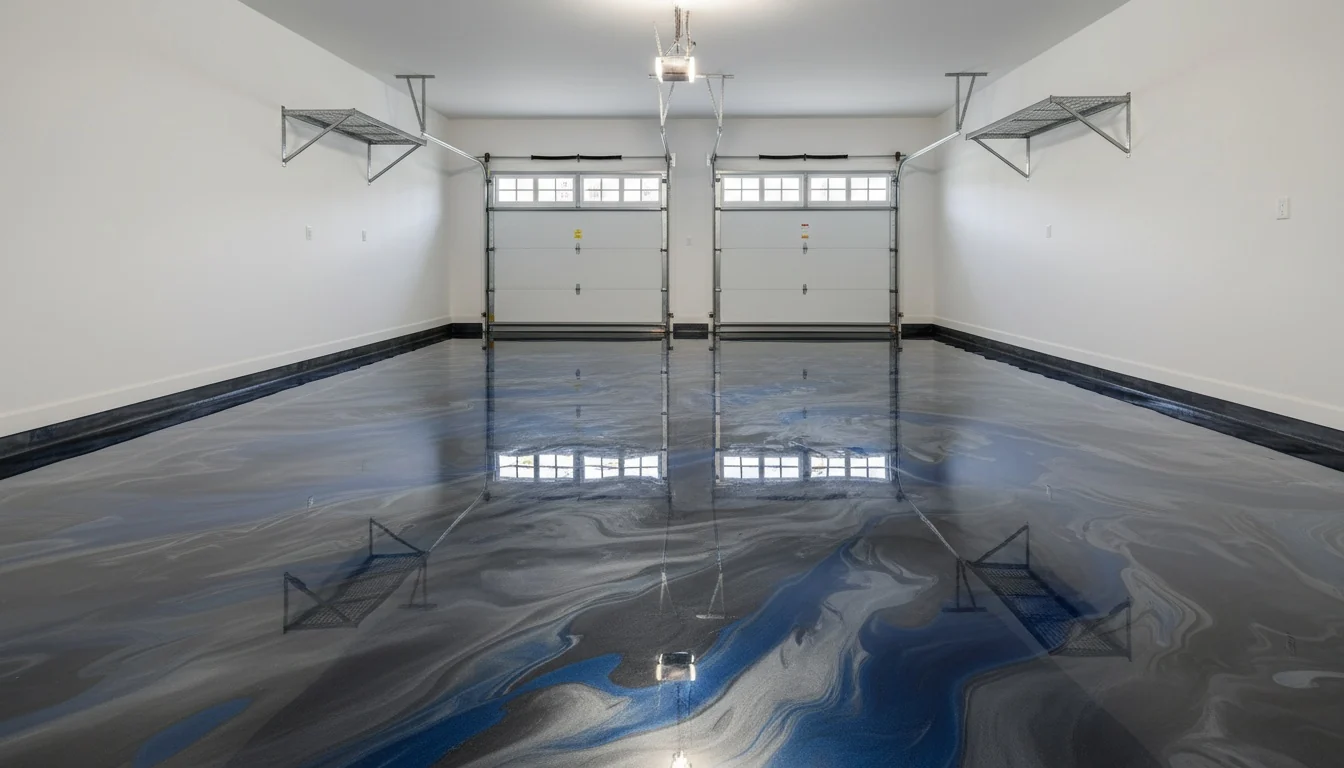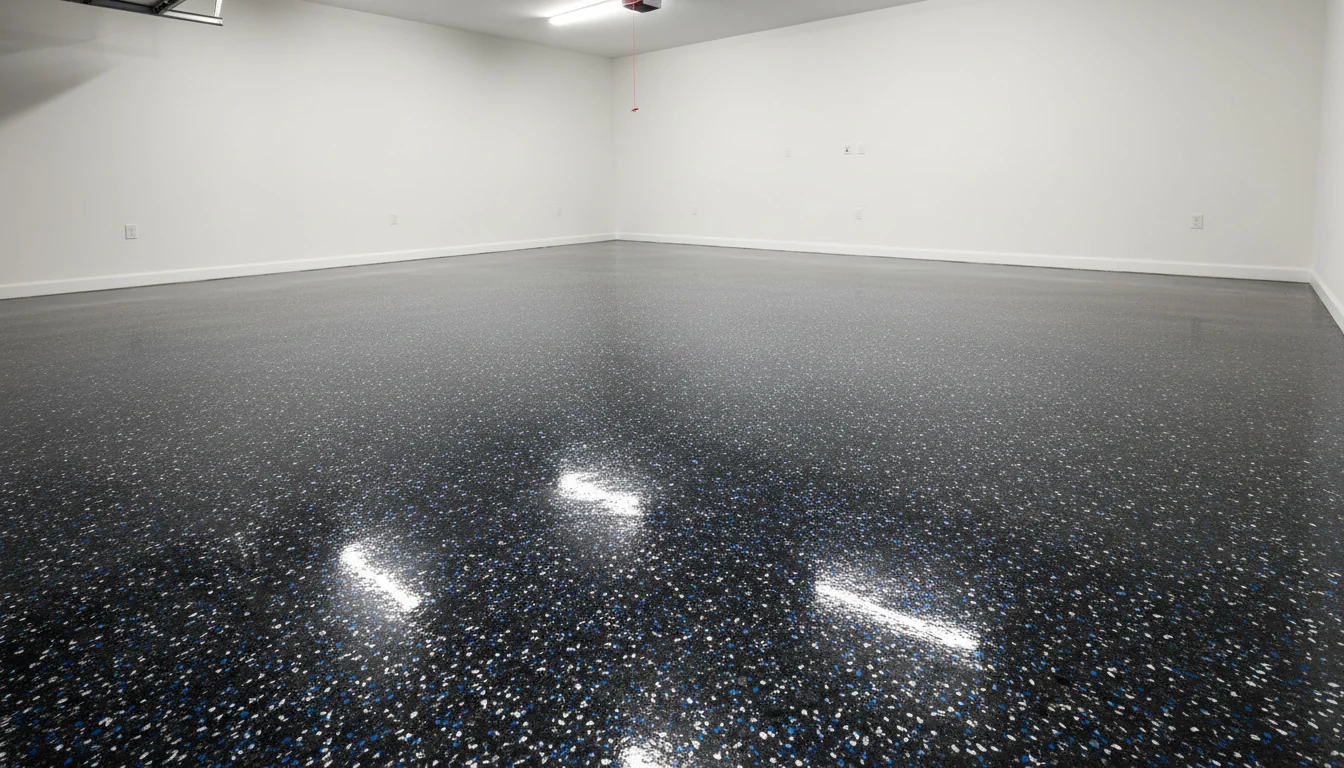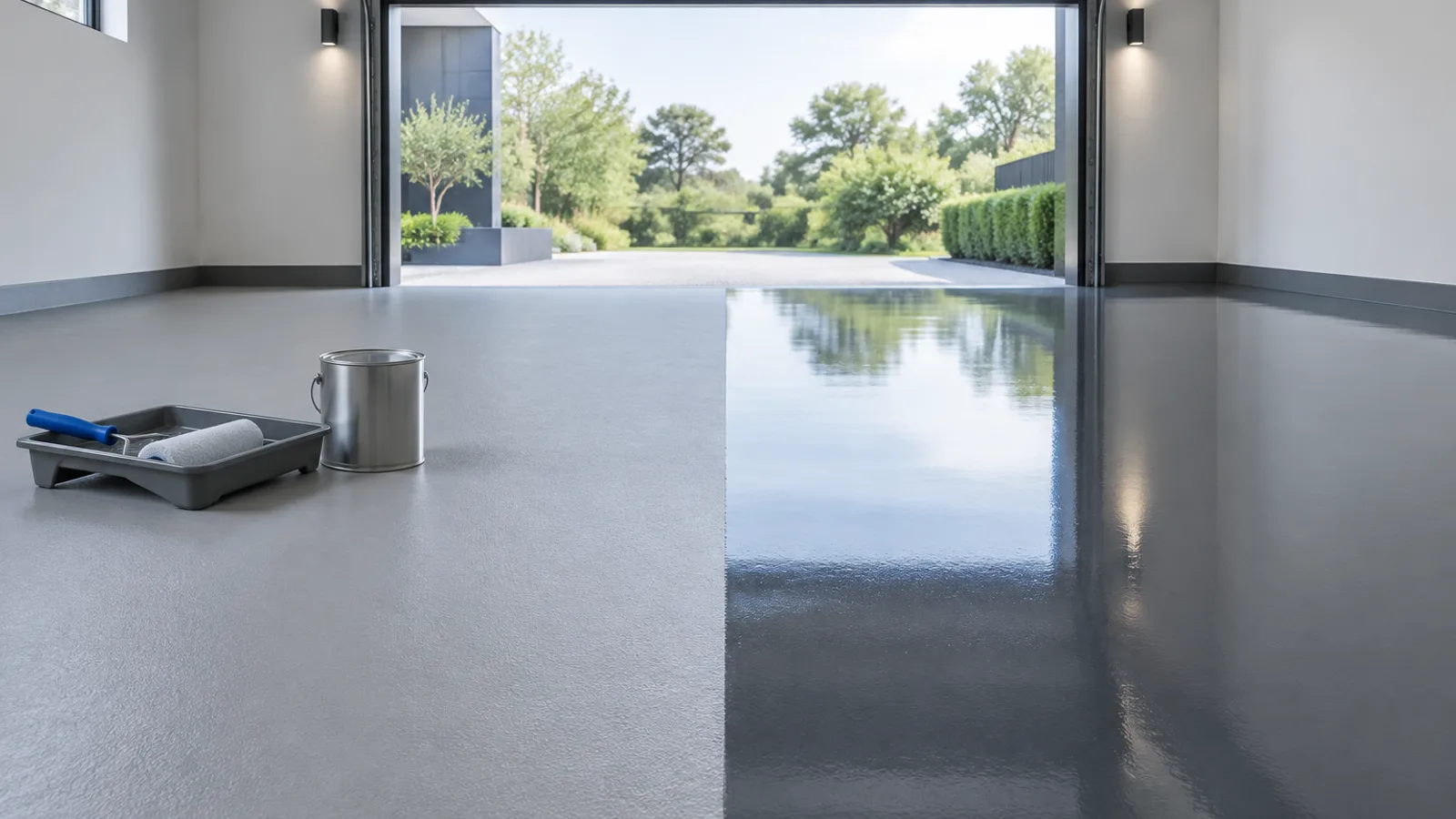

A 5 litre tin of garage floor paint costs about R1,000 to R2,400 at South African retailers, and one tin can cover a single garage. An installed epoxy floor in Cape Town starts at R480 per square metre, so the same garage is from about R8,640. That gap is real, and for some floors the tin is the right call. People search for the 20 litre price of epoxy floor paint every month, so we priced the tins ourselves, read the makers' own datasheets side by side and worked out what a garage costs each way.
The short version: the tin is cheaper by thousands of rands, but the datasheets ask you to do the preparation a professional floor includes, and all three epoxy paints whose datasheets we read say they are for indoor use only. Here is what we found, product by product.
Key takeaways
- Paint for a single garage (18 m²) costs from about R1,135 in one 5 L tin of single-pack acrylic, or about R3,238 in two 5 L two-pack epoxy kits, on prices we read on 22 November 2026. Our installed floor starts at about R8,640.
- The major brands sell two-pack epoxy floor paint in 5 L kits. We found no 20 L two-pack epoxy floor paint from them; the 20 L tins are single-pack paints.
- Every datasheet puts preparation first: acid etch or abrade, neutralise, keep the slab dry, and wait for new concrete to cure.
- Alcolin, Medal and Dulux say their epoxy floor paints are for indoor use; Alcolin warns direct sunlight yellows it.
- Dulux allows light vehicles on its epoxy enamel after 7 days at 23 °C, and warns that below 15 °C it takes some days just to reach handling hardness.
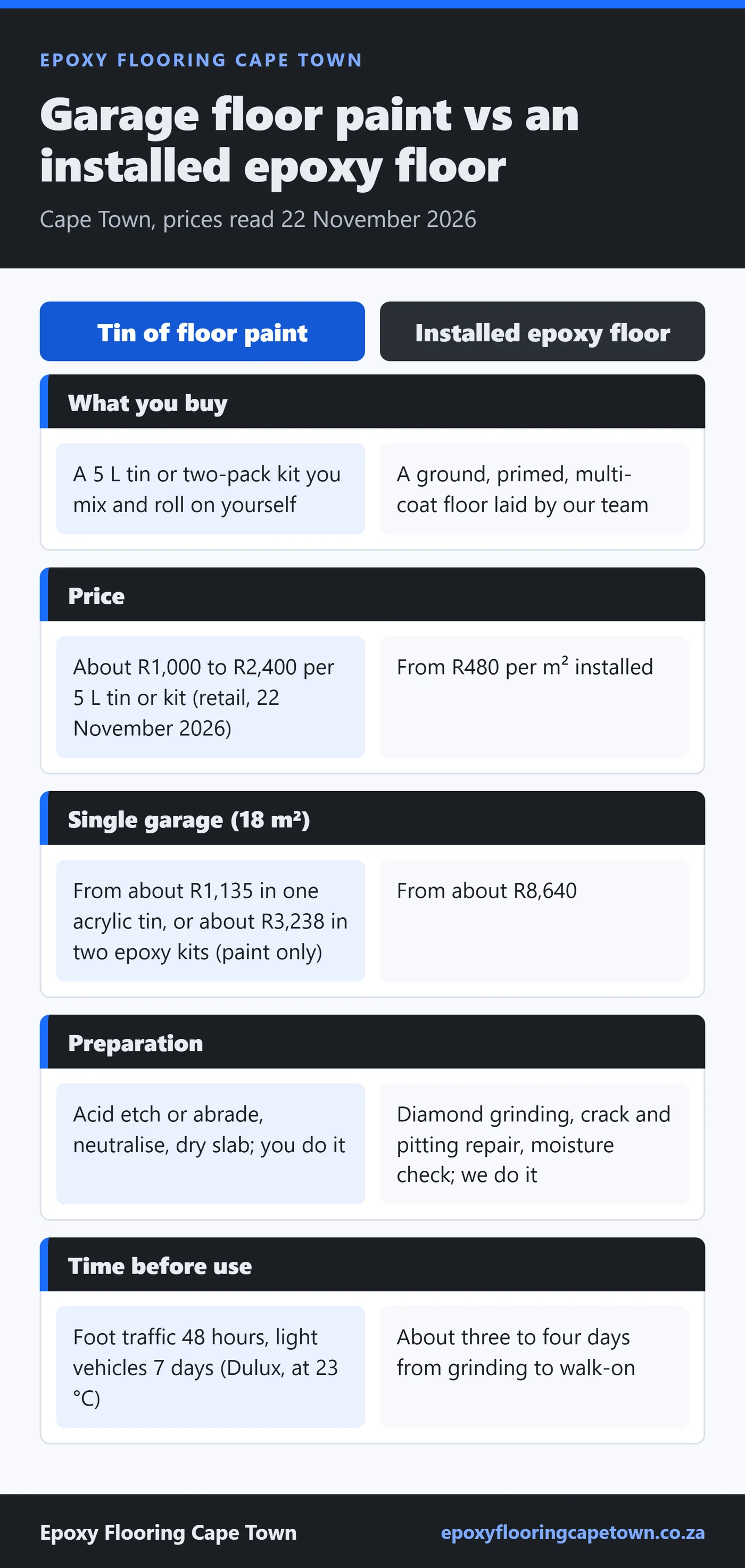
Tin or installed floor: the side-by-side
| Tin of floor paint | Installed epoxy floor | |
|---|---|---|
| What you buy | A 5 L tin or two-pack kit you mix and roll on yourself | A ground, primed, multi-coat floor laid by our team |
| Price | About R1,000 to R2,400 per 5 L tin or kit (retail, 22 November 2026) | From R480 per m² installed |
| Single garage (18 m²) | From about R1,135 in one acrylic tin, or about R3,238 in two epoxy kits (paint only) | From about R8,640 |
| Preparation | Acid etch or abrade, neutralise, dry slab; you do it | Diamond grinding, crack and pitting repair, moisture check; we do it |
| Time before use | Foot traffic 48 hours, light vehicles 7 days (Dulux, at 23 °C) | About three to four days from grinding to walk-on |
What the datasheets actually say
Retail listings sell floor paint on toughness and easy cleaning. The makers' technical data sheets are more useful, because they say how far a litre goes, how many coats it needs, when you can use the floor and where the paint should not go. These are five floor paints sold in South Africa, in the makers' own words, translated into a table.
| Product | Type | Coverage the maker states | Coats | Ready for use | Indoors or out |
|---|---|---|---|---|---|
| Dekro Painter's Pal Garage Floor Paint | Single-pack, water-based acrylic | 8 m² per litre per coat, at a 40 micron dry film | At least 2 | Hard dry in 6 hours at 23 °C; no traffic time given | Not stated |
| Alcolin Epoxy Floor Paint | Two-pack, water-based epoxy, mixed 1:1 | About 30 m² per coat per 5 L kit | 2 | Hard set 24 hours; full cure 3 days | Indoor only; yellows in direct sun |
| Medal Epoxy Floor Paint (MI005) | Two-pack epoxy, 4 L base to 1 L hardener | About 6 to 8 m² per litre | 2 | Hard dry 48 hours; fully cured 7 days | Indoor only |
| Dulux Trade Hi-Chem Epoxy Enamel | Two-pack epoxy enamel | About 9 m² per litre at 35 microns (it recommends 50 to 60 per coat) | 2 to 3 | Foot traffic 48 hours; light vehicles 7 days at 23 °C | Indoor only; chalks outdoors |
| Duram Showfloor Polyurethane Floor Paint | Single-pack, water-based polyurethane | 7 to 8 m² per litre per coat | 2, over its own primer | Light traffic after 24 hours; full service after 7 days | Indoor and outdoor |
Three things stand out. First, these are thin films. Dekro's coverage figure is for a 40 micron dry coat, Plascon quotes its Stoep Enamel at 30 microns a coat, and Dulux asks for 50 to 60 microns per coat and a continuous film of at least 70 microns over two to three coats. Second, the times differ a lot. Alcolin's epoxy is fully cured in 3 days; Medal's takes 7, and Dulux's makes you wait 7 days before light vehicles. Third, only Dulux gives a vehicle time at all.
Hot tyres are a problem particular to garages: warm tyres soften a weak coating, and it lifts as they cool. Here the makers do make claims: Alcolin rates its epoxy floor paint "Good" for hot tyre pick-up, Duram says Showfloor resists it, and Dekro's pamphlet calls its paint a floor coating "with tyre resistance". None of them publishes a test figure behind the claim, and Medal and Dulux do not mention hot tyres at all. We explain why it happens in our guide to whether a garage epoxy floor is worth it.
What a garage costs in tins
To compare like with like, we took the same two floors the epoxy flooring cost guide uses: a single garage of 18 m² and a double of 36 m². The tin quantities below are our own sums from each maker's coverage figure and the number of coats it recommends. They are paint only: rollers, mixing paddles, etching acid and any grinder hire are extra.
- Dekro Painter's Pal (single-pack acrylic). At 8 m² per litre per coat and two coats, a single garage needs 4.5 litres, so one 5 L tin. The grey was R1,134.55 on Dekro's own online shop on 22 November 2026, which works out at about R57 per m² of floor. A double garage needs 9 litres: two tins, R2,269.10.
- Alcolin Epoxy Floor Paint (two-pack epoxy). Alcolin's own formula is floor area times coats, divided by 30. For a single garage that is 1.2 kits, so you buy two. A 5 L kit was R1,619 at one national online retailer and R2,139 at a DIY chain on 22 November 2026, so a single garage is about R3,238 to R4,278, and a double garage needs three kits: about R4,857 to R6,417.
- Excelsior Twin-Pack Epoxy Floor (4 L base and 1 L catalyst) was R1,699 at the same DIY chain, and Dulux Hi-Chem Epoxy Enamel 5 L with hardener was R2,399 at the same online retailer, both on 22 November 2026. We could not open a datasheet for the Excelsior kit, and Dulux quotes its coverage at a thinner coat than it tells you to apply, so we have not turned either into a cost per m².
Against that, our installed epoxy floor starts at R480 per m²: from about R8,640 for a single garage and about R17,280 for a double, before flake, metallic or extra preparation. Material costs have pushed prices up recently, so we confirm the figure on site. The tin is clearly cheaper. The question is what the extra money buys.
Is there a 20 litre epoxy floor paint?
Not from the big names we checked. Alcolin sells its epoxy floor paint as a 5 L kit (2.5 L base and 2.5 L activator). Excelsior's is 4 L plus 1 L of catalyst, Medal's is mixed 4 L of base to 1 L of hardener, and Dulux's is a 5 L pack with hardener.
The 20 L tins you will find are single-pack paints. Dekro makes its water-based acrylic garage floor paint in 5 and 20 litres, and Excelsior Stoep Medium Grey came in a 20 L tin at R2,599 at a DIY chain on 22 November 2026. A stoep enamel and an acrylic floor paint are useful products, but they are not the two-pack epoxy the search is usually looking for.
The preparation the tin asks you to do
This is the part most people skip, and it is written into every datasheet we read:
- Give the surface a key. Alcolin says smooth, power-floated concrete must be acid etched or mechanically abraded, and that acid-etched floors must then be neutralised with ammonia and water. Dulux asks for an acid etch with hydrochloric acid. Plascon asks for carborundum grinding or abrasive blasting of smooth areas, and Dekro asks for smooth surfaces to be etched.
- Take old paint off. Alcolin says old painted surfaces must be mechanically abraded and all the paint removed.
- Keep it dry. Dulux wants no more than 12% moisture content. Plascon asks for less than 5%. Alcolin says its paint is not suitable where there is rising damp. Duram describes a test: tape a 30 cm square of clear plastic to the floor and leave it for 24 hours.
- Let new concrete cure. Dulux asks for at least 6 weeks, Duram at least 28 days, Plascon at least 4 weeks.
- Prime where told. Duram makes its Showfloor primer mandatory on every surface, and says the system is not for concrete heavily soaked with oil.
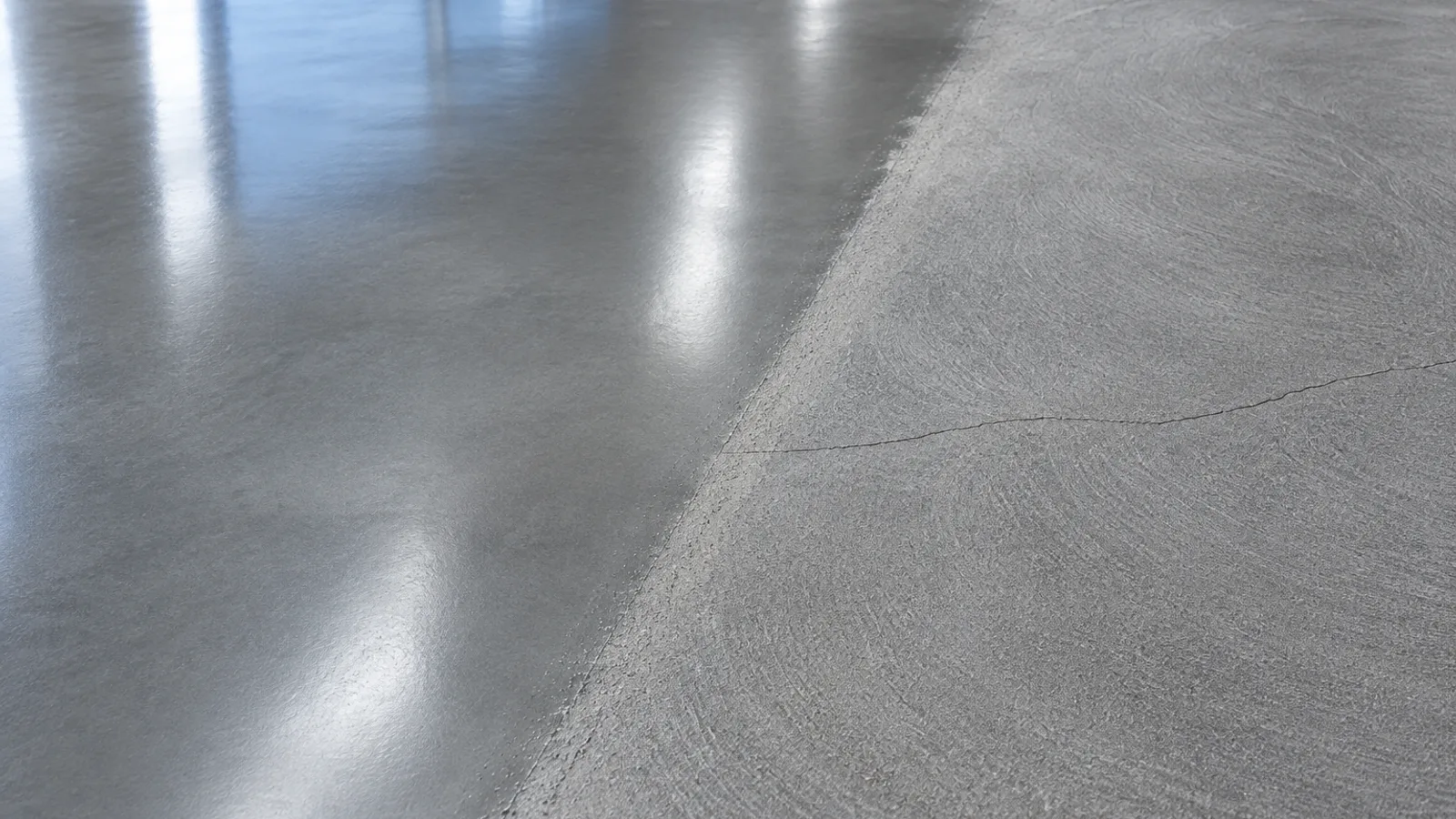
If you do this properly, a weekend of painting becomes several days of etching, rinsing, drying and testing. If you do not, the makers tell you what happens. Dekro's pamphlet lists poor preparation, latent moisture and laitance (the weak, dusty skin on top of concrete) as causes of paint adhesion problems, and its fix is to remove the coating back to the concrete and repeat the whole process.
Cold garages and cure times
Every cure time above is quoted at 23 or 25 °C. A Cape Town garage in a winter cold snap can be well below that, and Dulux says so directly: its epoxy cures slowly at low temperatures, and below 15 °C it takes some days to reach handling and recoating hardness. If you paint in winter, plan for the floor to be out of use for longer than the tin suggests. We cover the same effect on professional floors in how long an epoxy floor takes to dry.
What you get for R480 a square metre
An installed floor is not a better tin of paint. It is a different job. We diamond-grind the slab to open the concrete, fill cracks and pitting, and check for moisture before any coating goes down. Then we lay a primer, build coats and a clear topcoat. That grinding is the step the datasheets replace with acid etching, because a homeowner rarely has a floor grinder.
We use systems from Sika, Technical Finishes and Kwikrete, and we hold an accreditation from Technical Finishes. A single or double garage takes us about three to four days from grinding to walk-on. If you want a different finish, a polyurethane floor costs around R685 per m², and our garage floor epoxy service page shows the flake and solid-colour options.
When the tin is the right answer
We would rather you spend R1,135 on paint than R8,640 on a floor you do not need. A tin makes sense when:
- the slab is dry, sound and already reasonably smooth, with no damp coming up;
- the space is a storeroom or light-use garage where the main goal is to stop concrete dust;
- you are prepared to etch, neutralise and dry the floor first, and to wait out the cure time;
- the area is indoors, or you choose a paint the maker rates for outdoor use.
An installed floor makes more sense when the slab is cracked, dusty, damp or previously painted, when you want a flake or metallic finish, or when the garage is a workshop that takes oil, tools and daily parking. If you are not sure which side your floor falls on, we will look at it for free and tell you honestly, including when a tin would do. Ask for a free on-site assessment.