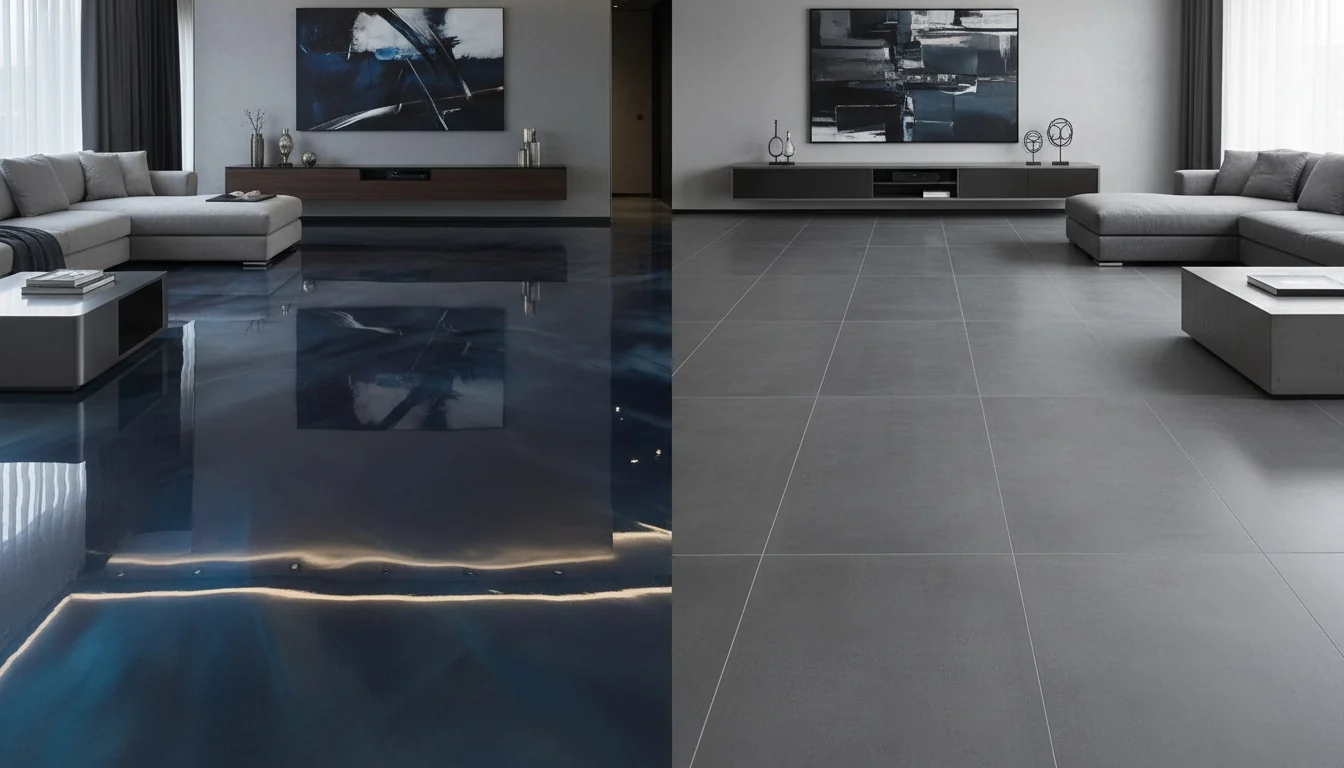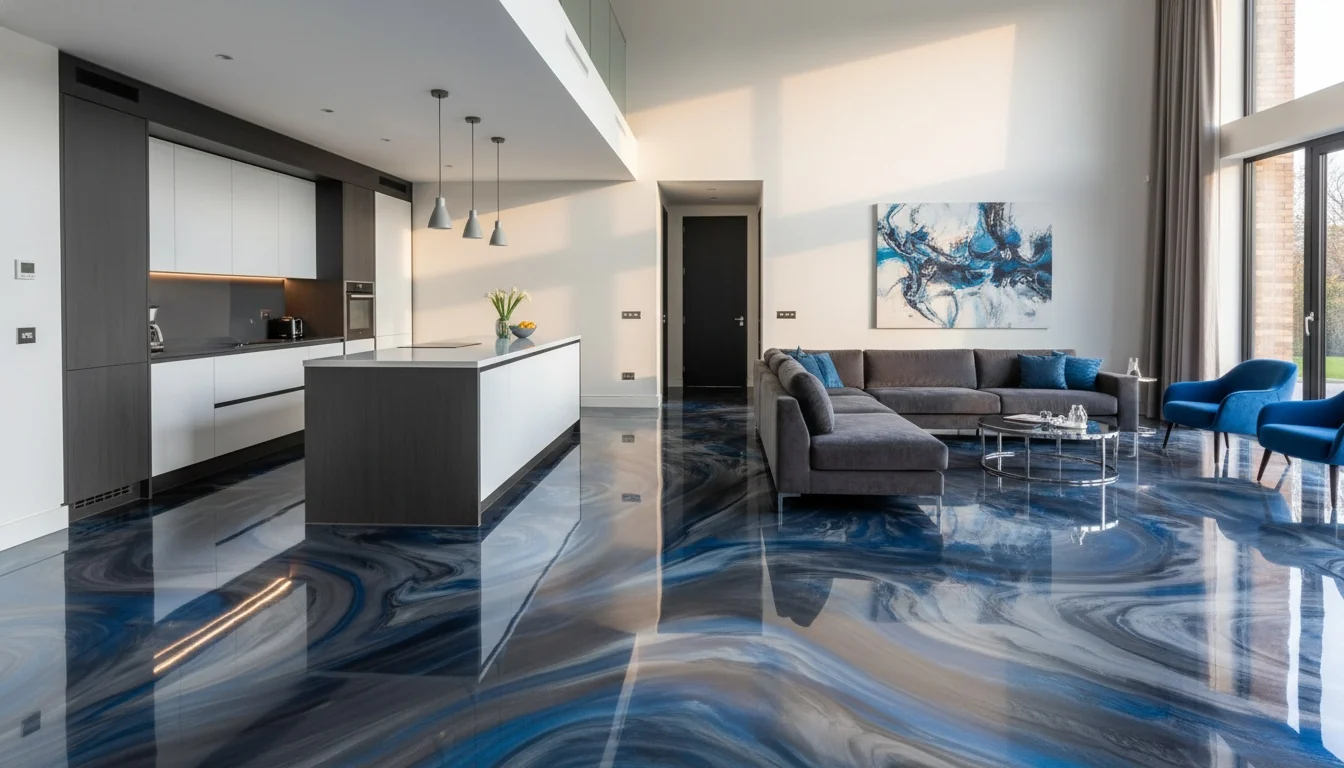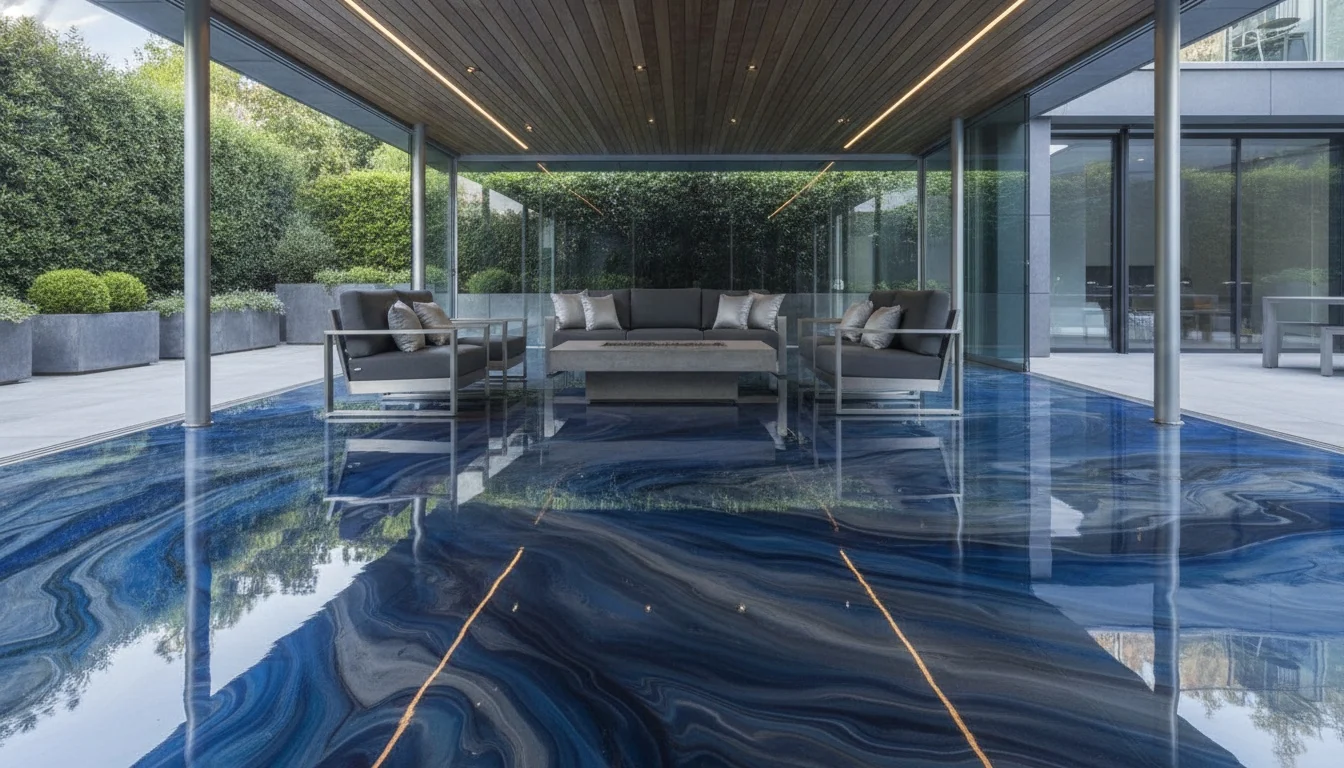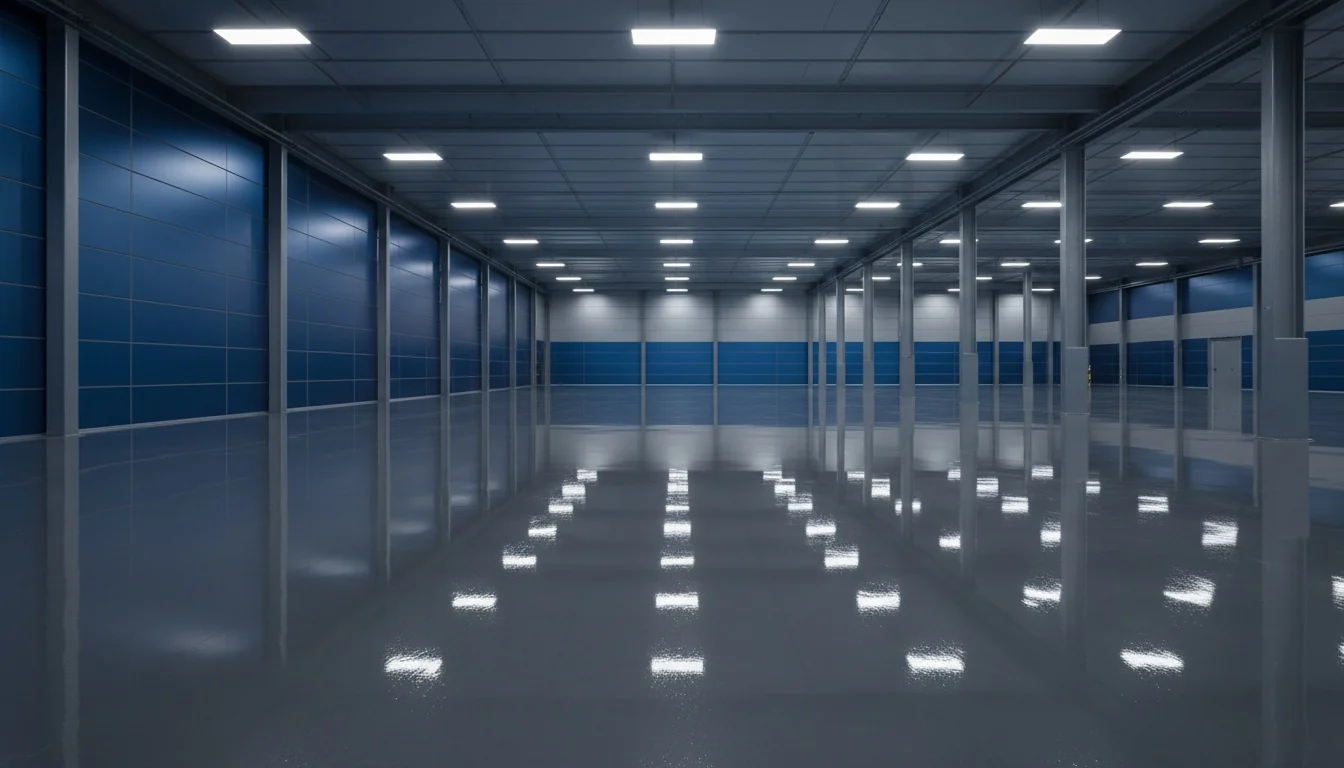

It is one of the most practical questions a Cape Town homeowner can ask. You have a tiled kitchen, patio or entrance hall that you have gone off, you like the look of a seamless resin floor, and lifting all that tile sounds like a fortnight of dust and skips. So: can you apply epoxy flooring over tiles, and leave what is already down where it is?
The honest answer is sometimes, under specific conditions, and it is not the default that a lot of marketing suggests. In a professional resin-flooring specification the instruction is usually the opposite of what people hope for. This guide sets out what the standards actually say, the four checks that decide whether your floor is a candidate, and what happens on the jobs where the tiles genuinely have to come up.
Key takeaways
- In a specified commercial resin floor, the standard instruction is to remove the tiles, adhesive, bedding and grout, not coat over them.
- The British code of practice for resin flooring covers bonding to concrete slabs, screeds and existing concrete floors. Tile is not a substrate it contemplates.
- In a home, coating over tiles can work when four things hold: sound bonding, a dry slab, the glaze fully ground off, and filled grout lines.
- Grout joints telegraph through a coating unless they are filled and levelled first. Thin coatings show preparation most.
- Leaving tiles down is not automatically cheaper. Glaze grinding, joint filling and a levelling coat can absorb most of the saving on removal.
What the flooring standards actually say
Start with the professional position, because it is clearer than the consumer advice and it explains why good installers get cautious about this job.
A typical NBS resin-flooring specification handles existing floor coverings in a single blunt clause. Under the heading for existing tile and sheet floor coverings, the preparation instruction reads: remove coverings, residual adhesive, bedding, grouting and pointing. There is no option to abrade the tiles and coat over them. For a specified job, the tiles come up.
The British code of practice for synthetic resin floorings points the same way by omission. It gives recommendations for resin floorings bonded to direct-finished concrete slabs, to polymer-modified cementitious or fine concrete screeds, and to existing concrete floors. A tiled floor is not in that list. The trade association guidance for resin flooring works from the same base assumption: the substrate is concrete or screed, prepared back to a sound, open profile.
None of that means an over-tiles floor is guaranteed to fail. Plenty of them are laid in homes every year and look excellent for a long time. It does mean you should treat "we can just go over your tiles" as a claim to test rather than a reassurance, because the people writing the specifications for hospital and factory floors have decided it is not a risk worth taking when a warranty is attached.
The four checks that decide it
When an installer assesses a tiled floor for coating, they are working through four questions. Fail any one and the recommendation shifts to lifting the tiles.
1. Are the tiles firmly bonded?
Epoxy is only ever as strong as what it is stuck to, and coating over tile creates a second bond line: the resin to the tile, and the tile to the slab. You inherit the weaker of the two. If a tile is loose, the coating on top of it goes wherever that tile goes.
The field check is the tap test. The installer works across the floor tapping the surface and listening: a solid, dull note means the tile is properly bedded, while a hollow ring means a void underneath. A few drummy tiles can be lifted, re-bedded and made good. A floor that rings hollow across large areas is telling you the whole covering is on borrowed time. On commercial work this is confirmed with a pull-off test, where a dolly is glued to the surface and pulled until something lets go, and the point of failure tells you where the weak plane is.
2. Is the slab dry?
This is the check people skip, and it is the one that causes the most expensive failures. Tiles and their adhesive are relatively tolerant of moisture rising through a slab. A sealed resin coating is not. It traps vapour underneath, pressure builds, and the floor lifts in patches months later.
Resin flooring specifications typically require the substrate to be at or below 75% relative humidity before laying, measured properly rather than judged by eye. The catch with a tiled floor is that the tiles hide the slab, so a meaningful reading usually means lifting tiles to get at the concrete. Older Cape Town homes and ground-level slabs without an effective damp-proof membrane are exactly where this bites. If the reading is high, the answer is a surface damp-proof membrane or a different specification, not a hopeful coat of resin.
3. Can the glaze be removed?
Epoxy grips mechanically. It needs a surface with texture to key into, and a glazed ceramic or porcelain tile is the opposite of that: hard, sealed and polished. The glaze has to be ground off with diamond tooling until the face is uniformly dull, and every trace of wax, sealer, soap residue and grease has to come off with it.
Some porcelains are hard enough to make this slow, expensive work. That is usually the moment the sums change, because the grinding time needed to de-glaze a large porcelain floor can cost more than lifting it would have.
4. What happens at the grout lines?
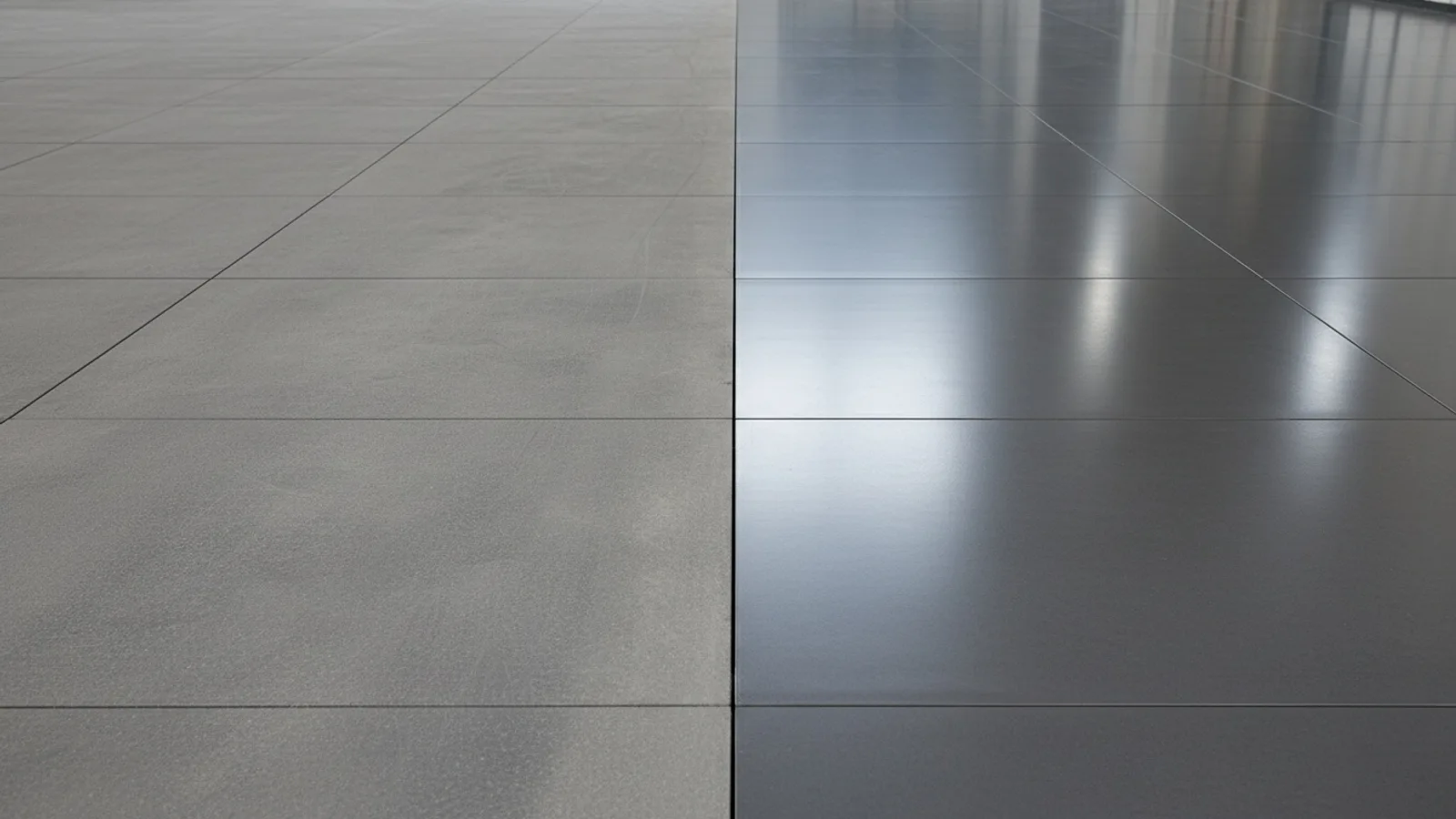
A resin coating follows the profile of whatever it is poured over. It does not bridge a recess. Specifications note that thinner resin floorings reflect the surface preparation in the finish, which in plain terms means every grout joint left open will read through the cured floor as a visible grid.
Filling and levelling the joints first solves it, and that is standard practice on a good over-tiles job. It also adds material, labour and build height, which matters more than people expect at doorways, thresholds and against existing skirtings. Deep or wide joints may need a full levelling coat across the whole floor, at which point you are paying for most of a new substrate anyway.
Coat over, or lift first?
Put together, the assessment usually resolves into a fairly clear go or no-go. The table below is the shape of the decision, though it is a guide rather than a substitute for someone standing on your actual floor.
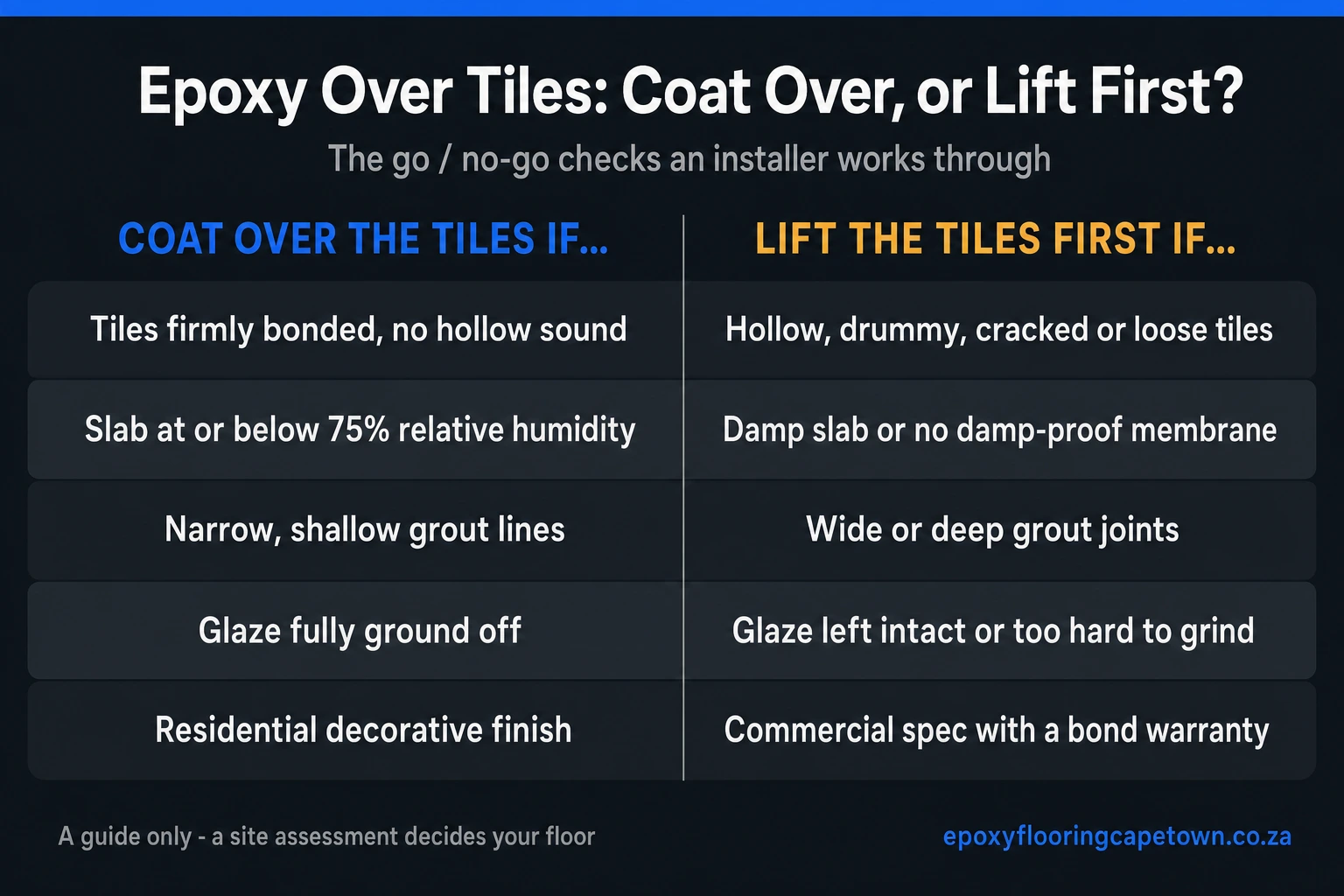
| Coat over the tiles if… | Lift the tiles first if… |
|---|---|
| Tiles firmly bonded, no hollow sound | Hollow, drummy, cracked or loose tiles |
| Slab at or below 75% relative humidity | Damp slab or no damp-proof membrane |
| Narrow, shallow grout lines | Wide or deep grout joints |
| Glaze fully ground off | Glaze left intact or too hard to grind |
| Residential decorative finish | Commercial spec with a bond warranty |
Epoxy over concrete: the job this was designed for
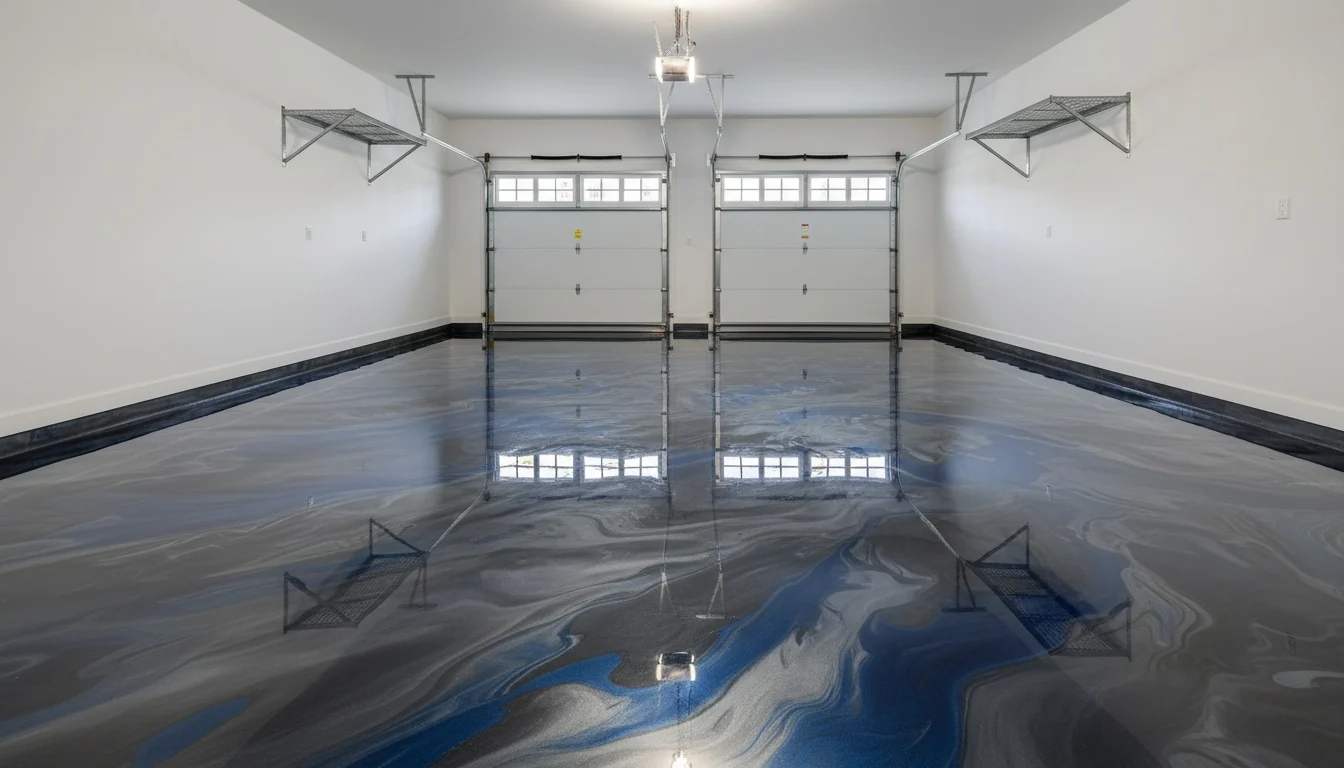
It is worth saying plainly that concrete is the substrate epoxy actually wants. Epoxy over concrete is the straightforward version of this job: diamond grind the slab to a clean open profile, repair cracks and joints, test moisture, prime, then lay the coats. No glaze to remove, no grout lines to fill, and one bond line instead of two.
That is the quiet argument for lifting tiles when the assessment is borderline. You are not just removing a problem, you are moving onto the surface the whole system was designed around. The preparation underneath is what decides how long the floor lasts, far more than the brand of resin that goes on top of it, and a coating bonded straight to properly ground concrete starts from a much stronger position.
Cost, and the assumption worth checking
Most people arrive at this question assuming that leaving the tiles down is the cheap option. It can be, but the gap is often narrower than expected. Coating over tiles removes the demolition and disposal cost, then adds glaze grinding, joint filling, frequently a levelling coat, and the extra assessment work needed to prove the floor is sound and dry.
Lifting the tiles adds labour and rubble removal, and gives back a substrate that is faster to prepare, easier to guarantee and free of the two failure modes that dominate over-tiles work. The sensible move is to have both priced on the same site visit rather than deciding in advance. If you are still weighing the surfaces themselves rather than the method, epoxy vs tiles covers that comparison on cost, durability and upkeep.
The bottom line
Can epoxy flooring be applied over tiles? Yes, in the right conditions, and no as a general rule. The professional standard for a specified floor is to take the tiles up, and the code of practice for resin flooring assumes a concrete or screed substrate throughout. In a home, over-tiles work is a legitimate option when the tiles are solidly bedded, the slab is dry, the glaze can be ground away and the joints are filled and levelled properly.
What it is not is a shortcut. Every check above exists because someone skipped it and the floor failed. The practical next step is to have someone tap the floor, take a moisture reading and tell you honestly which of the two jobs yours is. Experienced installers handle both routes as part of residential installations across Cape Town, and will price the tiles-up and tiles-down options side by side. Arrange a quote and get that assessment on paper before you commit either way.